
Feeding Tips to Support Your Child at Mealtimes
Mealtimes can be one of the most connecting parts of the day and, at times, one of the most frustrating. Many parents share worries such as:
“Is my child eating enough?”
“Why won’t they try anything new?”
“Am I being too strict, or too soft?”
While feeding challenges are a common part of childhood, small and thoughtful shifts in how we respond can make a big difference in not just what children eat, but in how they feel about food and family meals.
The strategies below are shared in the hopes of supporting parents as they navigate the everyday ups and downs of family meals.
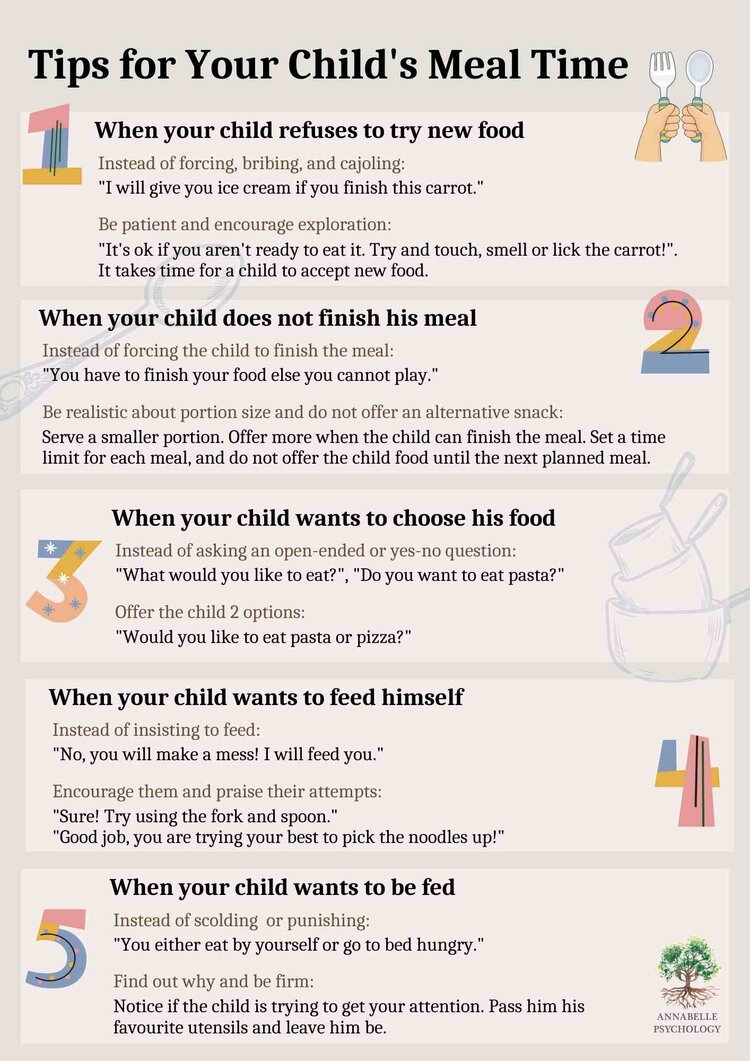
(1) When Your Child Refuses to Try New Food
It's very tempting to negotiate or to push a little harder when you’re worried they aren’t getting enough vegetables.
For example: "I’ll give you ice-cream afterwards if you finish this carrot.”
Instead, try giving them time and encouraging gentle exploration:
“It’s okay if you’re not ready to eat the carrots. You can touch it, smell it, or even give it a little taste.”
Children often need repeated exposures (sometimes many!) before they feel comfortable accepting a new food. When we remove pressure, we lower anxiety and children who feel less anxious or scrutinised at the table are far more likely to experiment.
(2) When Your Child Does Not Finish Their Meal
It can feel instinctive to say: “You have to finish your food, if not you cannot play.”
However, consistently pressuring children to clear their plates can interfere with their internal hunger and fullness cues. Over time, this may make it more difficult for them to self-regulate their appetite.
Instead:
Serve a smaller portion first
Offer more if they finish and are still hungry
Keep to regular meal and snack times
Avoid offering alternative snacks immediately after a refused meal
Structure provides security. When children trust that another meal or snack is coming at a predictable time, they are more able to listen to their own bodies rather than eating out of pressure or fear.
(3) When Your Child Wants to Choose Their Food
Open-ended questions like “What do you want to eat?” can be overwhelming, and yes/no questions like “Do you want to eat pasta?” often invite an automatic “No.”
Instead, offer two structured choices: “Would you like pasta or rice?”
This approach supports autonomy while keeping you in charge of the menu. Children feel respected and involved, and you avoid becoming a short-order cook.
(4) When Your Child Wants to Feed Themselves
It can be hard to watch food land on the table instead of in their mouth. However, self-feeding is not just about nutrition. It builds:
Motor coordination
Confidence
Independence
Body awareness
You might say:
“Sure! You can try using the spoon.”
“Good job, you are trying your best to pick up those noodles.”
Praise the effort, not just the outcome. Even if the food does not make it to their mouth, acknowledge the attempt. Messy efforts are part of learning and a sign that development is progressing well.
(5) When Your Child Wants to Be Fed
Sometimes children who are capable of self-feeding begin asking to be fed again.
Instead of scolding or punishing them with: “You either eat by yourself or go to bed hungry.”
Pause and reflect. Are they perhaps:
Tired?
Seeking connection?
Feeling unsure or overwhelmed?
You can acknowledge their feelings while staying firm: "I know you’d like me to feed you. The spoon is right here. I’ll sit with you while you try.”
Often, what they truly need is reassurance or shared attention. Sitting beside them, making gentle conversation, or offering a few moments of connection can meet the emotional need without reversing the skill.
A Gentle Reminder for Parents
Feeding our children can be deeply emotional. It touches on our parental instinct to nurture and protect our children. When a child refuses food or struggles at the table, it can sometimes feel personal even when it is not.
Children are learning many things at once during meals. How to recognise hunger and fullness, how to tolerate new foods, how to develop independence, and how to participate in family routines. Progress rarely happens in a straight line. Some days will feel smooth, and others may feel challenging. What matters most is creating a mealtime environment where children feel safe to explore, listen to their bodies, and gradually build confidence with food.
If mealtimes are consistently stressful or highly restrictive, seeking professional guidance can be helpful. Early support can offer practical strategies and reassurance as you navigate these everyday challenges. If you have questions about your child’s feeding habits or would like support in navigating mealtime challenges, we welcome you to reach out.
Many parents also often struggle to encourage their children to eat their greens. If this is something that you’re experiencing too, with got you covered with this handy article.